
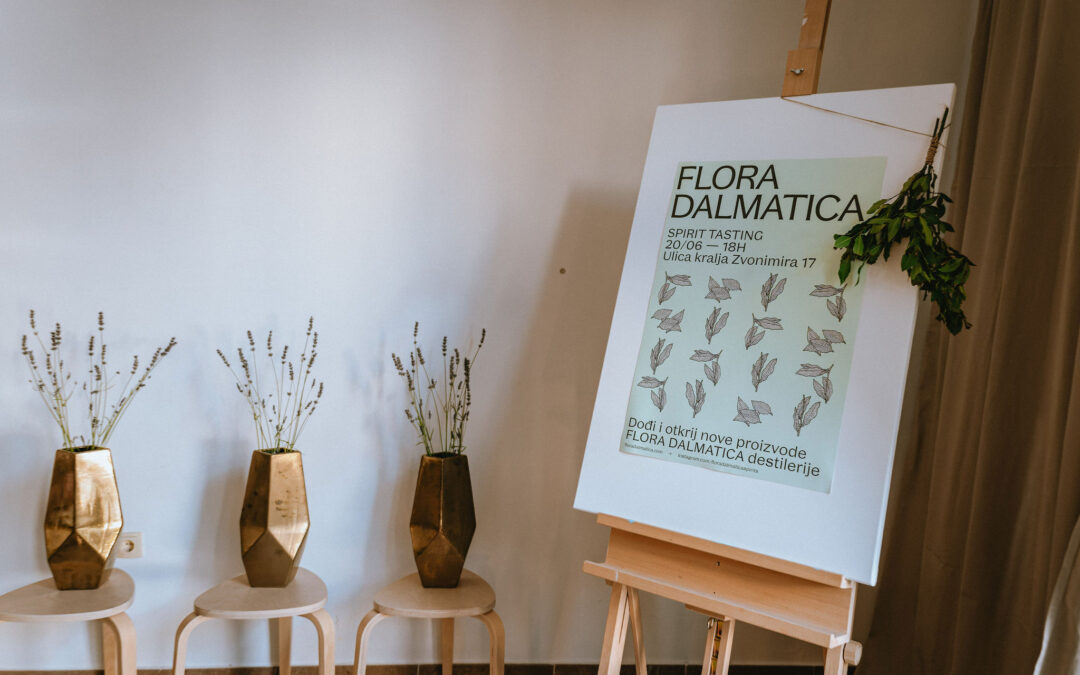
Flora Dalmatica: “Authenticity means staying true to your own experience and the story you want to tell.”
What happens when tradition, a micro-distillery, and the Šibenik hinterland come together?
Read the interview with Magdalena and Josip, founders of Flora Dalmatica and creators of its recipes.
Forget everything you thought you knew about gin. If your first associations are London bars, Instagram-friendly cocktails, or hipster labels competing for attention on the shelves, it’s time to reset your hard drive. Because somewhere between the rocky landscape of the Šibenik hinterland and a modern way of life, a story was born — one that pushes the boundaries.
Flora Dalmatica invites you to indulge in the present — without compromise, yet with deep respect for what nature provides. Perhaps that is precisely why the story of this distillery has become relevant far beyond the borders of Šibenik. Flora Dalmatica is not just gin; it is a question of authenticity in a world where even nature has its own branding.
It was the moment our story officially began — right where it was always meant to be.
We spoke with Josip Križanović Cimeša and Magdalena Šetka Jelković, the women behind the Croatian brand Flora Dalmatica, a small distillery that translates the tradition and wild botanicals of the Dalmatian hinterland into a contemporary, playful, and authentic gin.
M: Flora Dalmatica is more than a distillery. Did you envision it from the very beginning as a blend of landscape, culture, and modern life?
J: Flora Dalmatica began as a kind of memory of the Dalmatia we remember — a life connected to nature, plants, heritage, and everyday living. In the villages, herbs were gathered and used as both food and medicine; they were the foundation of life. Through plants, the cultural and historical heritage of our region is reflected, and we wanted to translate that spirit into a contemporary expression. In this way, tradition and modern life come together — because what is truly authentic never goes out of style.
We spoke with Josip Križanović Cimeša and Magdalena Šetka Jelković, the women behind the Croatian brand Flora Dalmatica, a small distillery that transforms the tradition and botanicals of the Dalmatian hinterland into a contemporary, playful, and authentic gin.
M: For me, Flora Dalmatica has always been a blend of where I come from and where I chose to live. I moved from Zagreb to Šibenik and discovered an entirely new world of scents, rhythms, and ways of life. That contrast opened my eyes — I realized that tradition and modern living can naturally complement each other.
M: What did the transition from idea to concrete product look like?
J: From the very beginning, the idea was to create a product that would first and foremost be acceptable to us. We started by asking ourselves: what would be a product we truly stand behind? That meant tasting different types of gin and carefully documenting every experience — flavor, aroma, aftertaste — to understand what we were aiming for. We wanted to map the characteristics that mattered to us.
In the end, we shaped our own sensory experience. We decided to highlight plants from the Dalmatian hinterland. My wish had always been to unite the flavors and aromas of the region where I grew up. While coastal Dalmatia is known for its Mediterranean notes, inland Dalmatia has its own distinct botanicals — intensely aromatic, oil-rich plants with unique character.
The recipe itself came to me “in a dream.” Relatively quickly, with minor adjustments, we arrived at the final product — Lör. Throughout the process, we eliminated botanicals that felt too heavy and searched for those that truly spoke our language. What completed the story was the aftertaste — the final impression that carries the experience beyond the first sip.
One defining decision was removing that “perfumy” note we often encountered in other gins — something unfamiliar, something that didn’t belong to our story or location. We wanted aromas we recognized, flavors that carried the identity of the Dalmatian hinterland. A major turning point was choosing bay leaf instead of cardamom — an authentic, resilient Mediterranean plant that heals, strengthens, and rounds out the flavor beautifully.
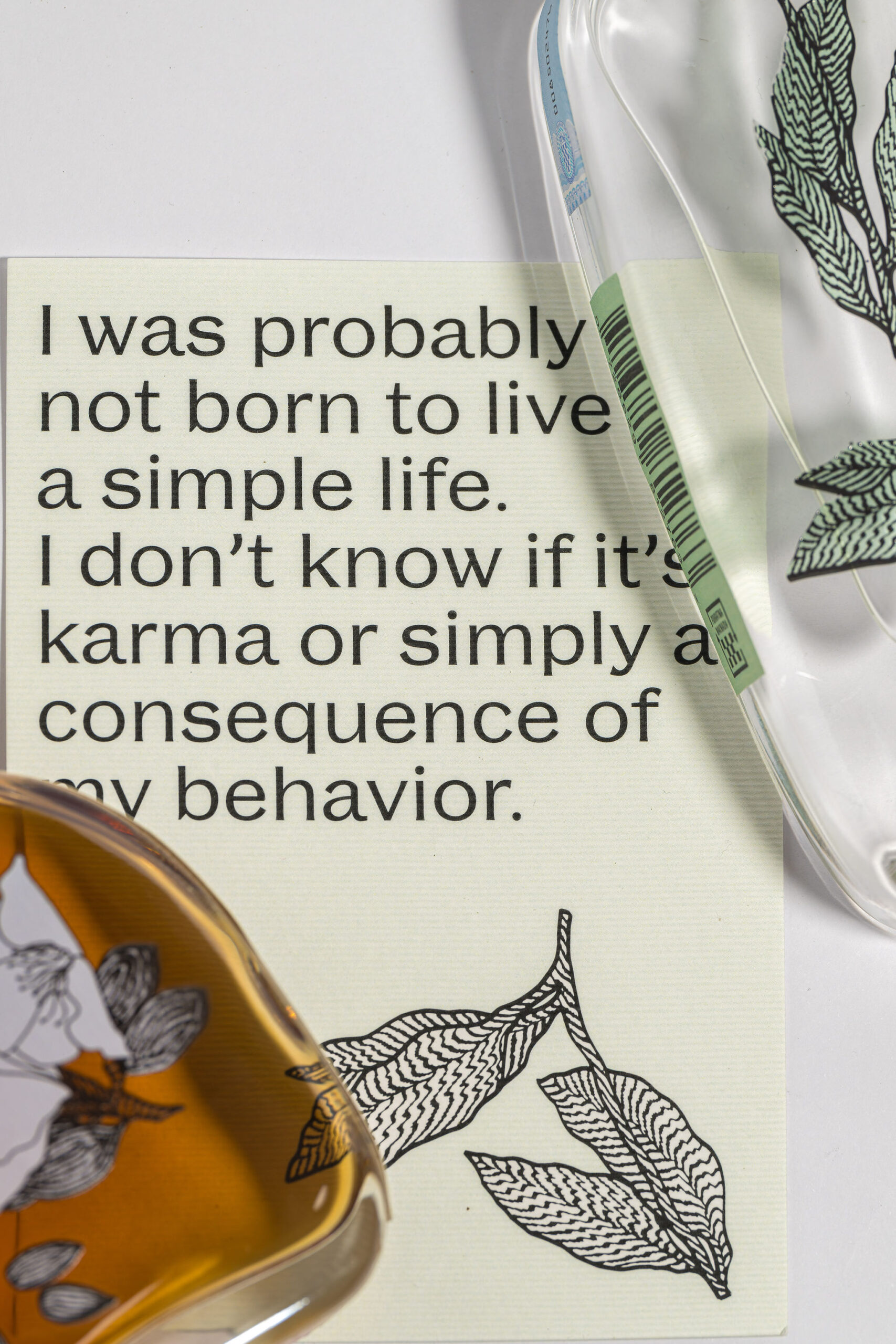
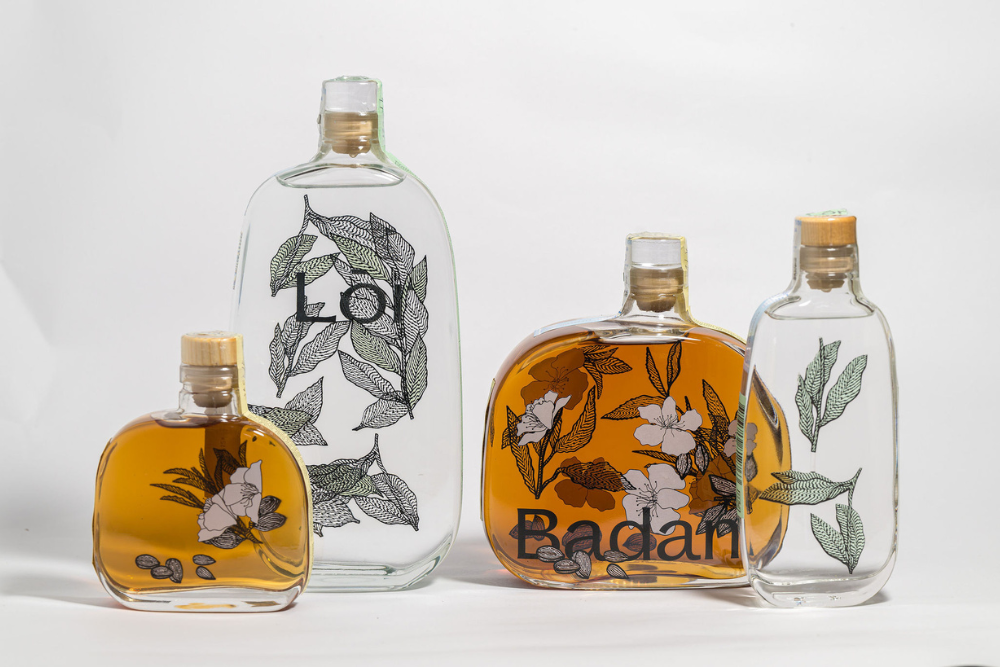
Bay leaf became central to our narrative and is now featured on the bottle as a kind of signature for Lör. Throughout the process, we moved through stages of learning — observation, gathering technical knowledge about maceration and distillation — but also developing sensitivity: how to taste, how to smell, when a plant has given its best, when to stop, when to emphasize certain notes. The entire creation cycle of Lör took around six months, because we realized that every step matters if you want a product that feels complete.
We are still learning — and for me, that is the most beautiful part of the process.
M: The process was exciting for me precisely because everything was new — from the first tastings to the notes about flavors and aromas. I observed and learned, but I also brought a “fresh” perspective, perhaps less burdened by tradition. Together, we searched for what made sense to us. It was important to me that the taste remained clean and recognizable, without unnecessary layers — and above all, that it was mixable. When we arrived at a combination that truly conveyed the character of the Dalmatian hinterland, I knew that was it.
Values and Nature
M: Which values from childhood and growing up in Dalmatia do you preserve in your work today?
J: Simplicity, connection with nature, and respect for what it provides. In Dalmatia, nothing was taken for granted — not food, not plants. People knew the right season, how to harvest properly, how to preserve aroma and strength. That connection to nature’s rhythm is still the foundation of our work.
M: I didn’t grow up in Dalmatia, but since living here, I feel like I’ve slowly adopted its rhythm. From my childhood I bring curiosity and openness; from Dalmatia I’ve learned patience. Nature dictates the tempo here — and that’s a value we now bring into every part of the process.
Hand-Picked Botanicals
M: Hand-picked herbs from the Šibenik hinterland carry a powerful narrative. How do you choose your plants, and how much does nature dictate the rhythm?
J: Plants always come first. Around 80% of our botanicals come from the Šibenik hinterland — from hidden slopes and untouched landscapes. They are gathered by people who truly know them, dried in traditional ways, and stored so they don’t lose their soul.
What always remains uncertain is the season. What kind of spring? What kind of summer? Most of our plants mature during that period. If there’s drought, some develop more essential oils — like immortelle or sage — as a natural defense. Others, like elderflower, may produce fewer blossoms or become more bitter. Nature sets the tone.
Our role is to extract the best from what each season gives and adjust the recipe accordingly. Sometimes that means reducing certain botanicals during maceration, sometimes increasing them.
Juniper berries, interestingly, do not come from Dalmatia but from the Kordun region. Since juniper defines gin’s character, we wanted it to be the backbone of our aroma.
M: Nature is the boss. We can plan, but every season carries something different. That unpredictability makes each batch unique — and I love that. Even though I’m not “from plants,” I am very much about taste, and that uncertainty makes the process alive.
The Alchemy of Distillation
M: Since distillation connects the material and the intangible, can you describe the moment when you feel “this is it”?
J: It’s an alchemical moment — when all components settle into place and create something noble, almost magical. When aroma and flavor unite and the final impression lingers beyond a single sip. It’s hard to rationalize; it’s more a feeling of harmony than a technical result.
M: It’s about harmony. Not just flavor, but the atmosphere it creates. When the first sip awakens everything you wanted to convey — the scent of the hinterland, freshness, authenticity — you know you’ve found it.
Experiment and Creation
M: Do you experiment with new combinations? Can you reveal anything that’s still “in the still”?
J: Experimentation has always been part of us — that’s how the story began. Right now, we’re focused on launching our two key products: Lör (a Mediterranean-style London Dry gin) and Badam (a bitter almond liqueur based on our gin).
Sometimes experimentation means small process adjustments; other times it leads to unexpected combinations that surprise us. Some trials will probably never leave the distillery, but they teach us and push us further. When we feel that the flavor has fully settled — that it has truly “clicked” — then we know it’s time to share it.
M: Experimentation is constant and honestly the most exciting part of the job. Behind the scenes, Hrvoje and Cimo are always stirring something new in the still — testing botanicals, exploring aromas. Sometimes we immediately know something won’t work; other times a scent or taste excites all of us. There’s a lot of observation, note-taking, discussion, and laughter. But when something clicks, you know it was worth it. Experiment is the living energy of our distillery.
Learning vs. Mistakes
M: How many times did you have to “fail” before reaching the right flavor?
J: We prefer to call it learning rather than failing. Every attempt brought new insight. Interestingly, the core recipe literally “came in a dream.” It evolved and refined over time, but the guiding thread remained the same — loyalty to the botanicals of the Dalmatian hinterland. It’s fascinating how many plants once used historically disappeared from recipes, even though they had strong influence. We would love to bring some of them back.
M: Every trial brought us closer to the taste we were searching for. The process takes time — and that’s exactly where the magic lies.
Connection with Customers
M: How do you connect with customers — through taste, aesthetics, or emotion?
J: I’d say emotion comes first. When you meet someone, you’re offering a part of yourself. This project wasn’t a calculated business move; it was a creative departure from our everyday realities — a new momentum in our lives. Our products were born from enthusiasm and the desire to reflect Dalmatia as we see and feel it. One of our key ideas was to create a gin that could be enjoyed neat, without additions — something distinctive and aromatic enough to stand on its own. The reactions have been wonderful.
Aesthetics are the second part of that whole. We’re happy people respond positively to the design — we wanted the entire experience to feel complete.
M: Emotion is always key. People react when they sense honesty and energy. But aesthetics matter too — we are visual beings. A bottle is often picked up first because of design. That’s why design and quality must go hand in hand: the bottle draws you in, the taste makes you stay.
Memorable Reactions
M: Is there a customer story that stayed with you?
J: We’ve had beautiful encounters. One couple from Norway told us they would remember Dalmatia during long winter evenings by the fireplace with our gin. I love that image. It reflects what we want to create — atmosphere. Enjoyment. Small moments.
M: I love seeing our gin live among people and their stories — among musicians, dancers, creatives. It travels through gatherings and performances. It really “plays and dances” with people. That’s when you know the product has come alive beyond the distillery.
Breaking Boundaries
M: What was it like launching a drink brand in a region where small producers aren’t always expected to push boundaries?
J: In Šibenik, creative shifts have been happening for some time. It feels more like a broader awakening than rebellion. Many who were once “small” are no longer small. We didn’t approach this as protest — more as an act of creation. And pushing boundaries is always a good thing.
M: I was surprised by how creatively and entrepreneurially alive Šibenik is. Flora Dalmatica felt more like a natural continuation of that wave than a rebellion. When you work sincerely, people recognize it.
Stereotypes
M: Did you face stereotypes as a small producer in what many perceive as an elitist or male-dominated industry?
J: Perhaps, but we didn’t give them much weight. Our female team strongly influenced the aesthetic side, while the male-female synergy in the entire process showed that quality ultimately breaks stereotypes.
M: I think we balance each other well. Women bring attention to detail; men bring strength to the process. In the end, quality speaks louder than stereotypes.
Success and Authenticity
M: What does success mean to you?
J: This is our form of creation. If we’ve managed to convey enjoyment, emotion, and enthusiasm to someone else, that’s enough for us.
M: Numbers matter for survival, of course — but not as a measure of value. For me, success is in the experience created. If someone tastes our gin and feels something — that’s success.
M: How do you see authenticity in a time when everything is branded — even nature?
J: Authenticity is essential. Branding is inevitable, especially in today’s digital world, but it should never exceed your own criteria and values. Authenticity lies in personal perspective — how you experience your product and your story.
M: Branding can be a tool, but what remains is sincerity. It’s important that every bottle feels truly ours — not something shaped by trends.
Where Do You See Flora Dalmatica?
M: Where would you most like to see Flora Dalmatica — on which shelf, in which bar, in whose hand?
J: Wherever every sip is truly enjoyed.
M: In places where people drink slowly — with good music and laughter. Or at home with friends who appreciate every sip. I love the idea of the bottle “dancing” on tables, among conversations and stories.
Local Identity & Beyond
M: Is it important for you to be present outside Croatia?
J: We are a micro-distillery. Every bottle is practically handmade. We want to grow thoughtfully and slowly. First locally — in Šibenik. Then Zagreb, not just for market reasons but because it’s also our city. Interest from abroad exists, but that’s part of long-term planning. Step by step.
M: Local identity is our core. Wider markets can come when we’re confident we’re telling our story the right way.
Final Question
M: When you look at your bottles, what do you want them to say instead of you?
J: Everything we want to say is already in them. It’s in the bottle.
M: Every drop is a mini adventure. The bottle simply whispers: “Come, feel, enjoy.” It’s in the bottle.
Author: Mamager | Published: 2I10I2025